Flexible funding as a catalyst: key insights from Mongolia's independent media
Press Releases
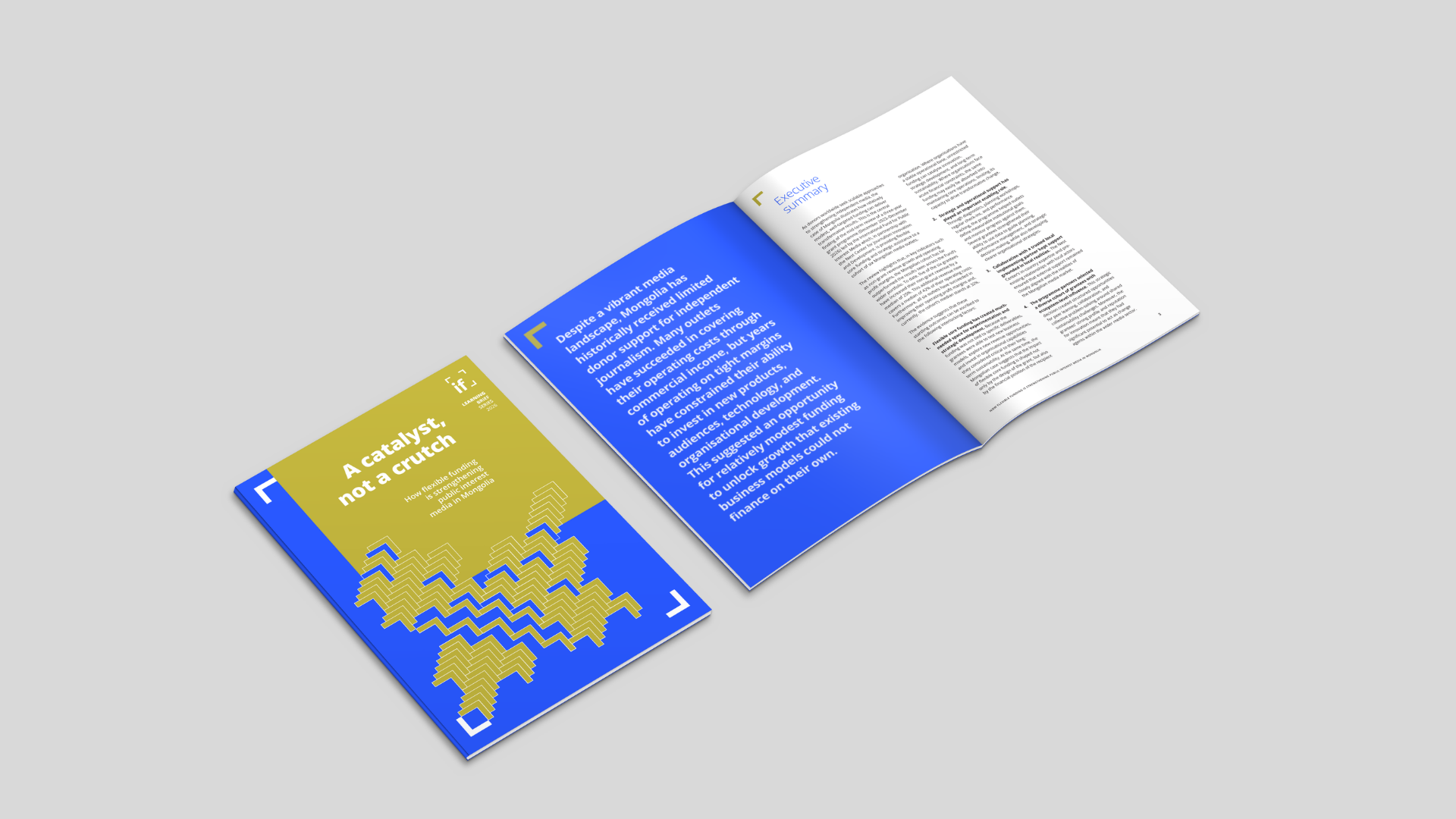
Located between Russia and China, Mongolia has a crowded media landscape. There are 389 active outlets for a population of 3.5 million, all competing fiercely for limited advertising revenue. A new learning brief from the International Fund for Public Interest Media (IFPIM), A catalyst, not a crutch, is a mid-term review of the International Fund’s three-year programme of flexible core funding and strategic support in Mongolia, which runs from December 2023 to December 2026 and is being delivered in partnership with the Nest Center for Journalism Innovation and Development. It draws on the experience of six outlets supported by the International Fund (Graph.mn, iToim, Lemon Press Digital, NTV, UB.life, and Zuunii Medee), setting out what has worked so far, why, and how these lessons might apply to funding public interest media elsewhere.
The early results are striking. In the first 18 months, five of the six grantees increased their non-grant revenue, with a median rise of 23%, compared with 15% across the International Fund’s wider portfolio. This revenue covers, on average, 42% of operating costs. All six improved their operating profit margins, even as costs typically rose by 41% because of new investments. Only three had positive margins at the start, and the cohort median now stands at 32%, against 7% for the wider portfolio. The cohort's workforce also grew by 6%, at a time when many newsrooms worldwide have been shrinking.
These gains came in a challenging environment. Many independent outlets cover their running costs through commercial income, but years of tight margins have left little room to invest in new products, audiences, or technology. Press freedom has also narrowed: Mongolia fell from 68th to 102nd in the Reporters Without Borders (RSF) World Press Freedom Index between 2021 and 2025.
The brief sets out five key insights. The first four explore the factors behind the cohort's performance, and the final one focuses on the enabling conditions that made it possible:
1. Building on solid foundations: flexible funding accelerated growth where the foundations were already in place. Most grantees already ran lean, commercially viable models, so unrestricted funding went into experimentation and strategic investment rather than day-to-day survival. iToim, for example, grew its non-grant revenue by 125% by shifting from one-off contracts to long-term advertising deals with ethical partners.
2. Turning funding into measurable outcomes: diagnostics, planning workshops, monthly check-ins, and performance tracking from FT Strategies and Nest helped outlets set clear, data-driven goals. Grantees cited strategic clarity as one of the programme's main benefits.
3. A trusted local partner: Nest's in-country knowledge shaped the grantee selection, the design of the support package, and legal assistance for outlets facing harassment. This has kept external support closely aligned with the realities of the Mongolian market.
4. Strengthening the wider sector through a cohort: bringing together a diverse group of influential outlets encouraged peer learning, joint reporting, and collective action. This included a coordinated response to a draft Press Freedom Law and shared work on a Mongolian-language AI tool that no single outlet could have built alone.
5. A convergence of favourable conditions: the results reflect commercially capable grantees, a relatively stable media environment, a responsive market with demand for trustworthy journalism, and strong local support. Where organisations face acute financial pressure, the same funding may simply be absorbed into keeping the lights on.
Together, the insights show how flexible funding, combined with strategic and local support, can accelerate the growth of independent media that is already on a sound footing. The findings are not yet final. A fuller picture of the grantees' long-term sustainability will only emerge after the programme ends in December 2026. Still, the Mongolian experience offers a valuable contribution to a pressing question for the sector: what makes funding a catalyst, not a crutch, for independent media?
Download the full learning brief: A catalyst, not a crutch: how flexible funding is strenghtening public interest media in Mongolia
About the learning brief series
This learning brief is part of a series produced by the International Fund's What Works Unit, which documents and analyses the experience of independent media in low- and middle-income countries to understand what works and what does not in responding to the political and structural market challenges facing public interest journalism.
Upcoming learning briefs:
Building sustainable audience revenue: a three-dimensional framework for independent media in fragile and emerging markets
When the audience steps up: why voluntary contributions have become increasingly central to independent media in Armenia, Moldova, and Ukraine
Previous learning brief: