.jpg)
From Threat to Reality - A Report on the State of Media
Press Releases
Rooted in research and consultation with independent media organisations in 30 middle- and low-income countries, this report argues that the weakening of democracy, security, and development is closely correlated with the near extinction of independent media. It demonstrates – with evidence – that financial support for independent media is one of the most cost-effective and impactful measures for shoring up democracy, increasing security and resilience to authoritarianism, and underpinning development.
Lead authors: Maha Taki, Director of the What Works Unit and James Deane, Director of Policy and Learning of BBC Media Action and IFPIM co-founder
The full report can be accessed on IFPIM's Publications and Resources page HERE
Executive Summary Key Findings:
› The political, security, democratic, and development consequences of the collapse of independent media are becoming more and more evident. Societies are increasingly poorly informed, disinformation shapes opinion, polarisation is becoming extreme and entrenched, an authoritarian culture is replacing a democratic one and governments are acting with impunity. In essence, the erosion of independent media – even in one country – has a ripple effect that destabilizes entire regions, weakens democratic norms globally, and threatens security.
› Financial survivability for independent media, already extremely difficult, has become near impossible over the last two years as authoritarian and other political forces invest ever more heavily in information operations and the co-option of independent media; as technology platforms’ algorithms and new developments in Artificial Intelligence (AI) further deprioritise or distort news provision; and as broader market conditions continue to deteriorate.
› International financial support for independent media has deteriorated sharply with the closure of USAID, the cessation of media funding by other US government-supported bodies such as the National Endowment for Democracy, and the reduction of development funding by other government donors. All this has combined with a decision by several major philanthropies, including the Open Society Foundation, to downscale or exit funding for independent media in the past year. The International Fund for Public Interest Media, established only two years ago, is now the largest of very few specialist donors remaining in many regions.
› Impacts on the ground are stark. In Eastern Europe, for example, media outlets in Ukraine, Armenia, Georgia, and Moldova have seen budget cuts of between 50% and 70%; in Latin America, independent outlets have typically faced budget cuts of between 15% and 40%. (5) For several years, independent media have faced increasingly difficult market conditions, political intimidation and co- option, and a technological tsunami that has crushed business models. The collapse of international assistance to media is having the effect that might be predicted in such conditions.
› The economic, technological, and political headwinds confronting independent media are intensifying. In particular, AI is being very effectively weaponised by those sowing disinformation. (6) For example, although AI-powered search engines rely heavily on independent news sites (7) for their training, AI decreases traffic to them and marginalises news generated in non-dominant languages. In most countries that IFPIM focuses on, operating conditions for independent media are also increasingly hazardous – political polarisation is intensifying, and conflict is frequently open and sometimes serious.
› Undermining the information space at scale is not cheap and supporting it is comparatively inexpensive. Russia is spending an estimated USD 1.5 billion (8) a year on its international propaganda operations. Other major authoritarian actors such as China are also investing heavily. While the information environment provides an extremely fertile environment for disinformation, this requires constant effort and investment. Evidence (9) suggests that one of the most effective ways to counter disinformation is through the sustained presence of independent, public interest media; it also indicates that the success of other approaches – such as debunking, media literacy and fact checking – depends ultimately on the easy availability of trustworthy information across the wider ecosystem. Independent media support requires potentially less investment, the burden of which can be shared across multiple like- minded democracies. (10) The broader economic benefits of the existence of independent media in mitigating authoritarianism are also becoming more valued. (1)1 Despite the cost effectiveness of independent media support – and autocracies’ accelerating investment in media co-option – democratic financial support to independent media has stagnated over the last decade. (12)
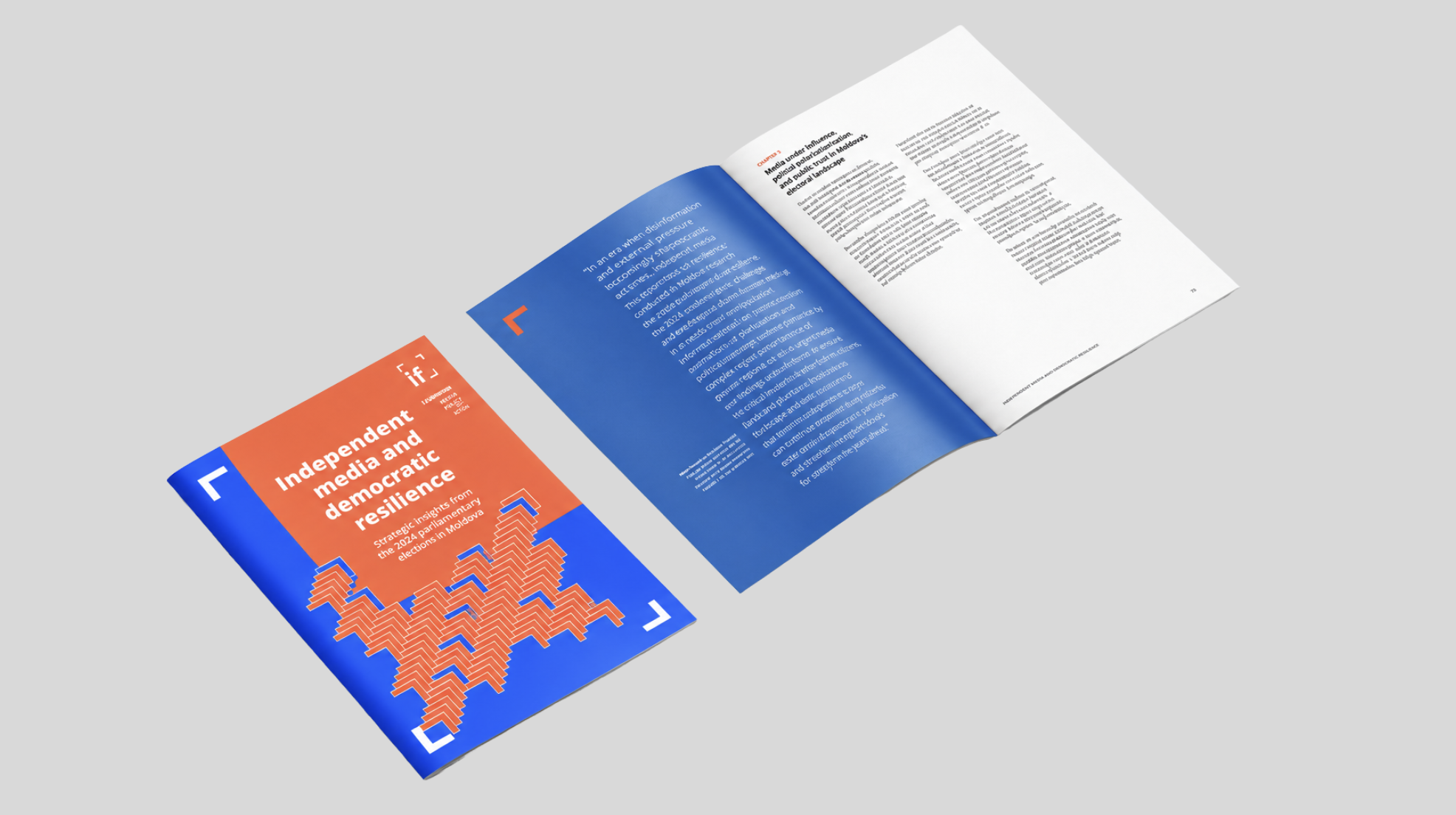
› Independent media that survive, increasingly due to grant funding, are demonstrating extraordinary impact. In Moldova, where Russia is said to have spent more than USD 100 million (13) in promoting proxy political parties and has waged a campaign of disinformation, independent media is largely credited with a key role in exposing these efforts and reaching and engaging with those most susceptible to Russian propaganda. (14) For example, after the online media organisation Ziarul de Gardă played a pivotal part in exposing election disinformation, twenty other local media organizations disseminated those investigations, amplifying their reach and impact. (15)
› The most impactful independent media tend to operate in the harshest economic conditions and are often the least sustainable. The International Fund’s experience suggests that those playing the most effective watchdog role are less able to attract local advertising, face obstacles in getting paying subscribers, are most subject to financial/political intimidation, and have to invest the most in their own legal and security protection. Their survival often depends on donor backing and extraordinary resilience.
› Despite deteriorating conditions, we know what works and promising solutions are emerging. Strategies with proven impact include providing core, flexible funding to strengthen institutions, launching national journalism funds to crowd in local and international revenue, and building equitable mechanisms to ensure tech platforms fairly compensate public interest media through licensing deals, digital taxes and other mechanisms. We are also seeing the emergence of promising initiatives working on the development of new technologies designed with the public interest in mind. Together, these examples show that coordinated, strategic investment can do more than sustain public interest media, it can help rebuild the information ecosystem
Citations:
1. These are: Eastern Europe: Armenia, Georgia, Moldova, and Ukraine; Africa and Middle East: Ghana, Kenya, Lebanon, Niger, Sierra Leone, South Africa, Palestine, and Tunisia. Asia and Pacific: Afghanistan, Indonesia, Mongolia, Nepal, Pacific Islands (Federated States of Micronesia, Fiji, Kiribati, Marshall Islands, Palau, Papua New Guinea, Samoa, Solomon Islands, Tonga, Tuvalu, and Vanuatu), Philippines, and Sri Lanka. Latin America & the Caribbean: Argentina, Brazil, Bolivia, Colombia, Costa Rica, Ecuador, and Paraguay.
2. Foreign Policy Centre, Decline in media freedom ‘hand-in-hand’ with democratic backsliding, June 26, 2025.
3. Organization for Security and Co-operation in Europe (OSCE). Media Freedom, Democracy and Security, 2024.
4. Media Development Investment Fund (MDIF). Media Development’s Role in Social, Economic, and Political Progress: Literature Review, 2023.
5. Insight from IFPIM’s regional teams based on interviews with grantees in above countries.
6. French Ministry for Europe and Foreign Affairs, Information Manipulation: A Challenge for Our Democracies, 2023.
7. Press Gazette, First Google Core Update of 2024 Brings Bad News for Most News Publishers, 15 March 2024.
8. This estimate is based on two sources that analysed Russian state budget allocations to government-controlled media outlets. See Debunk.org, Coining Lies: State Budget Financing of Russian Propaganda, 2023, and Centre for Eastern Studies (OSW), Weapons of Mass Deception: Russian Television Propaganda in Wartime, 6 May 2022.
9. Bateman J. & Jackson D, Countering Disinformation Effectively: An Evidence-Based Policy Guide. Carnegie Endowment for International Peace
10. For example, in 2024 IFPIM made an initial investment of just under EUR 1 million in Moldova supporting six organizations that played a proven role during the 2024 elections in mitigating externally sponsored disinformation.
11. A High Level Panel on Public Interest Media established by IFPIM and the Forum for Information and Democracy to consolidate the arguments on the economic value of independent media. It consists of Professor Daron Acemoglu (MIT, Turkey/USA), Prof. Tim Besley (London School of Economics, UK), Prof. Phillippe Aghion (INSEAD, France), Prof. Francesca Bria (UCL, UK), Prof. Diane Coyle (Cambridge, UK), Dr Obiagali Ezekwesili (School of Politics, Policy, and Governance, Nigeria), Prof. Ricardo Hausmann (Harvard Kennedy School, USA), Prof. Mariana Mazzucato (UCL, UK), Prof. Atif Mian (Princeton University, Pakistan/USA), Prof. Andrea Prat (Columbia University, USA), Dr Vera Songwe, (Liquidity and Sustainability Facility, UNECA and Afriexpimbank, Cameroon), and Prof. Joseph E. Stiglitz, (Columbia University, USA).
12. OECD DAC Mapping ODA to Media and Information Integrity 2023
13. Fredrik Wesslau, Russia’s Hybrid War Against Moldova: Escalation by Exploitation, Stockholm Centre for Eastern European Studies, 11 October 2024.
14. What Works Unit, Reaching Vulnerable Audiences in Moldova: Challenges and Solutions – A Learning Brief, IFPIM, 2025
15. Măriuța Nistor and Natalia Zaharescu, Serving Moscow, trans. by kompreno, published by Ziarul de Gardă, Moldova, European Press Prize, 2025.