New report sets out the economic, security & crisis response case for independent journalism
Press Releases
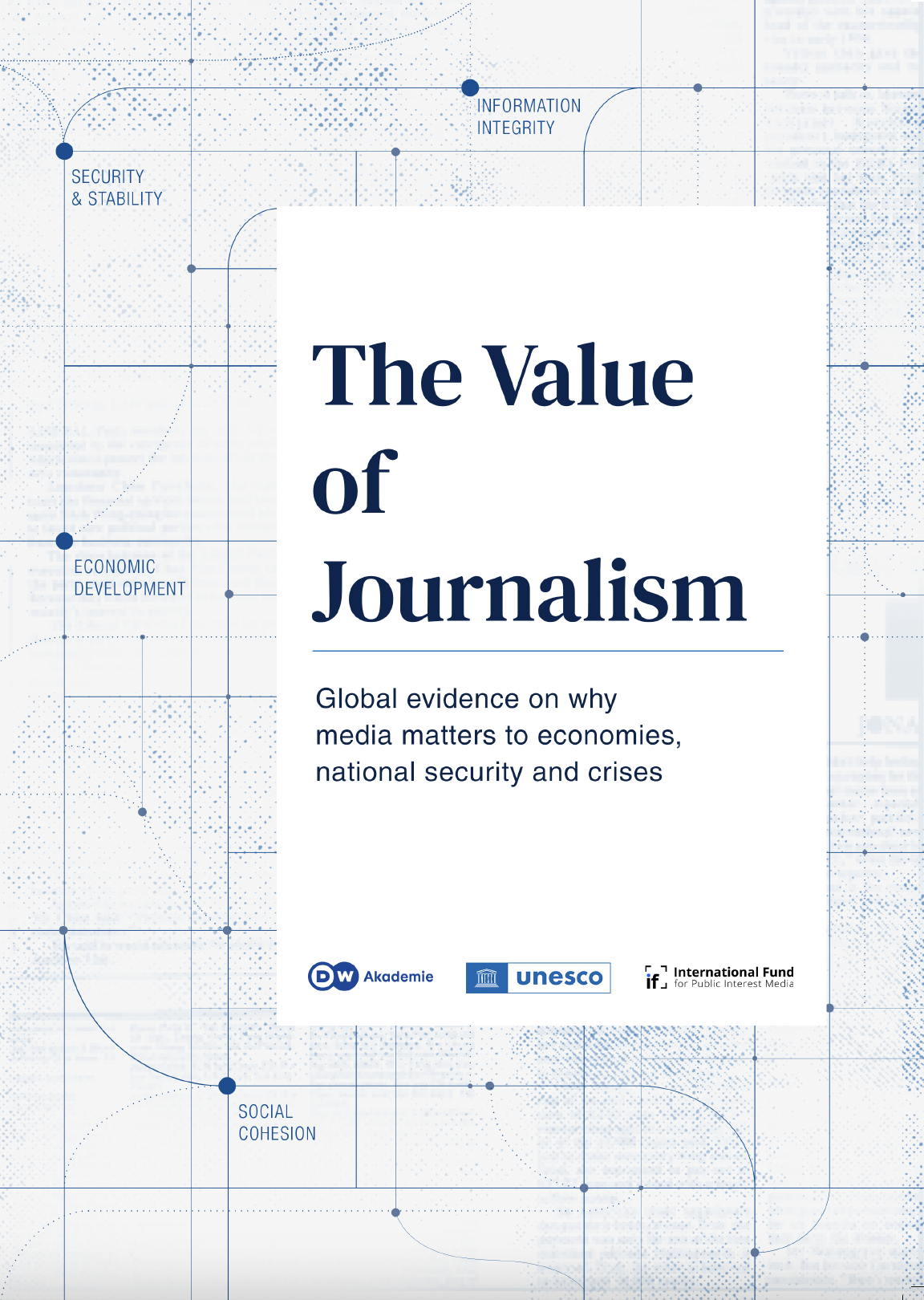
23 June, Paris: A new global evidence review commissioned by IFPIM in partnership with DW Akademie and UNESCO, entitled The Value of Journalism: Global evidence on why media matters to economics, national security and crises, demonstrates that free and independent media has a profound and positive impact on societies globally. The report shares data that underscores benefits to societies including economic growth, strengthened national security, and greater resilience against disinformation and crises.
Launched today during the Global Media Forum in Bonn, Germany, The Value of Journalism is published at a moment when the conditions for independent journalism are more precarious than at any point in recent history: public funding for media is declining, social media platforms and AI threaten media revenue streams, and drastic cuts to international aid and media development budgets have taken a severe toll. As a consequence, audiences worldwide are facing shrinking access to trusted sources of independent journalism and the reliable facts and information they provide.
Authored by Professor Mel Bunce and Dr Beth Pearson of City St George’s, University of London, the report synthesises the latest academic research into the value of journalism to explain its critical importance to economies, national security, and response to crises. It highlights the stakes for societies when journalism declines and disappears.
"The facts shared in this evidence brief speak for themselves,” said Maha Taki, Director of the International Fund’s What Works Unit, which oversees monitoring, evaluation and learning. “Yet many of the benefits of independent journalism remain under-recognised and under-valued. Today, when support for independent media is declining globally, it’s more important than ever to recognise that journalism is a public good that generates tangible benefits for societies: they are more prosperous, more resilient, and better equipped to respond to the complex challenges they face.”
Report data point highlights include:
- A study of 97 countries found that declining press freedom is associated with a 1–2 percent reduction in real GDP growth — and that this is slow to recover.
$1 invested in journalism can generate more than $100 in public savings through reclaimed funds, improved public services and reduced corruption.
A study of 97 countries found that declining press freedom is associated with a 1–2 percent reduction in real GDP growth — and that this is slow to recover.
Disinformation — which independent journalism is among the most effective tools to counter — costs societies an estimated $355–516 billion each year.
In 2026, the World Economic Forum ranked disinformation as the second most pressing global risk. Supporting independent journalism offers a comparatively low-cost opportunity: Experts estimate that 0.1% of global GDP – equivalent to just 15 days of global military spending – could fund healthy public media and secure information environments for citizens around the world.
Journalism-led fact-checking by AFP reduced the circulation of disinformation on the largest social media platform by approximately 8 percent, and reduced the rate of future sharing.
A study of 152 countries found that greater access to free media is associated with a reduction in human rights abuses and a lower likelihood of conflict and repression.
News coverage has a direct impact on humanitarian response: a study of 2,337 disasters found that every additional story in the New York Times generated an additional $500,000 in official emergency aid.
News coverage can accelerate health crisis response: Radio health programmes in Burkina Faso dramatically increased the rate at which caregivers sought treatment for children, reducing under-five deaths by 7.1 percent per year and saving an estimated 2,967 children's lives.
The report's launch coincides with the publication of the 2026 World Press Freedom Index by Reporters Without Borders (RSF), which found that just one percent of the world's population now lives in countries where press freedom is rated as "good." For the first time in the index's 25-year history, more than half of all countries fall into the two lowest rankings of press freedom: ‘difficult’ or ‘very serious’.
While drawing on the best available global research, the Value of Journalism evidence brief also highlights the need for more thorough evidence-gathering: noting that the majority of existing studies that served as the basis for the evidence brief were conducted in the United States and Europe, the report calls for greater research attention to Global South contexts.
The report was commissioned by the partner organisations as members of the Research Working Group of the Media Viability Manifesto initiative, which has set out a common framework for strengthened collaboration around the viability of independent media.
Download the full report: https://ifp.im/ValueofJournalism
About IFPIM:
The International Fund for Public Interest Media is the world's first and only multilateral fund dedicated to supporting independent journalism in low- and middle-income countries. Launched in 2022 and hosted by France, IFPIM is backed by 20 governments and philanthropic donors, operating across Africa and the Middle East, Asia and the Pacific, Latin America and the Caribbean, and Eastern Europe. The Fund supports independent media through two complementary approaches: by providing direct grants to individual media outlets, and by investing in ecosystem-level initiatives that strengthen the broader conditions in which independent journalism can thrive. IFPIM also convenes tech experts and media partners across the Global South to ensure AI strengthens — rather than undermines — the delivery of reliable information across languages, geographies, and platforms. To date, IFPIM has made 130 grants supporting 144 media organisations in 34 countries. Our vision is that people everywhere have access to reliable information about matters of public interest.


.jpg)