Forging a network of media outlets for collaboration and geographic reach in Argentina
Press Releases
Argentina is geographically the eighth-largest country in the world, spanning more than 3700 kilometres from north to south, with many rural communities located far from major cities and news infrastructure. Financial stress and an adverse political climate have weakened independent media outlets in recent years, and caused others to close their doors. As a measure of the public’s shrinking access to independent news and information, Argentina fell 21 places from 2024 to 2025 in RSF’s 2025 press freedom ranking, followed by a further 11 point drop to 98th place, out of 180 countries ranked in 2026. Against this backdrop, many rural communities have become virtual 'news deserts' with little or no access to editorially independent information.
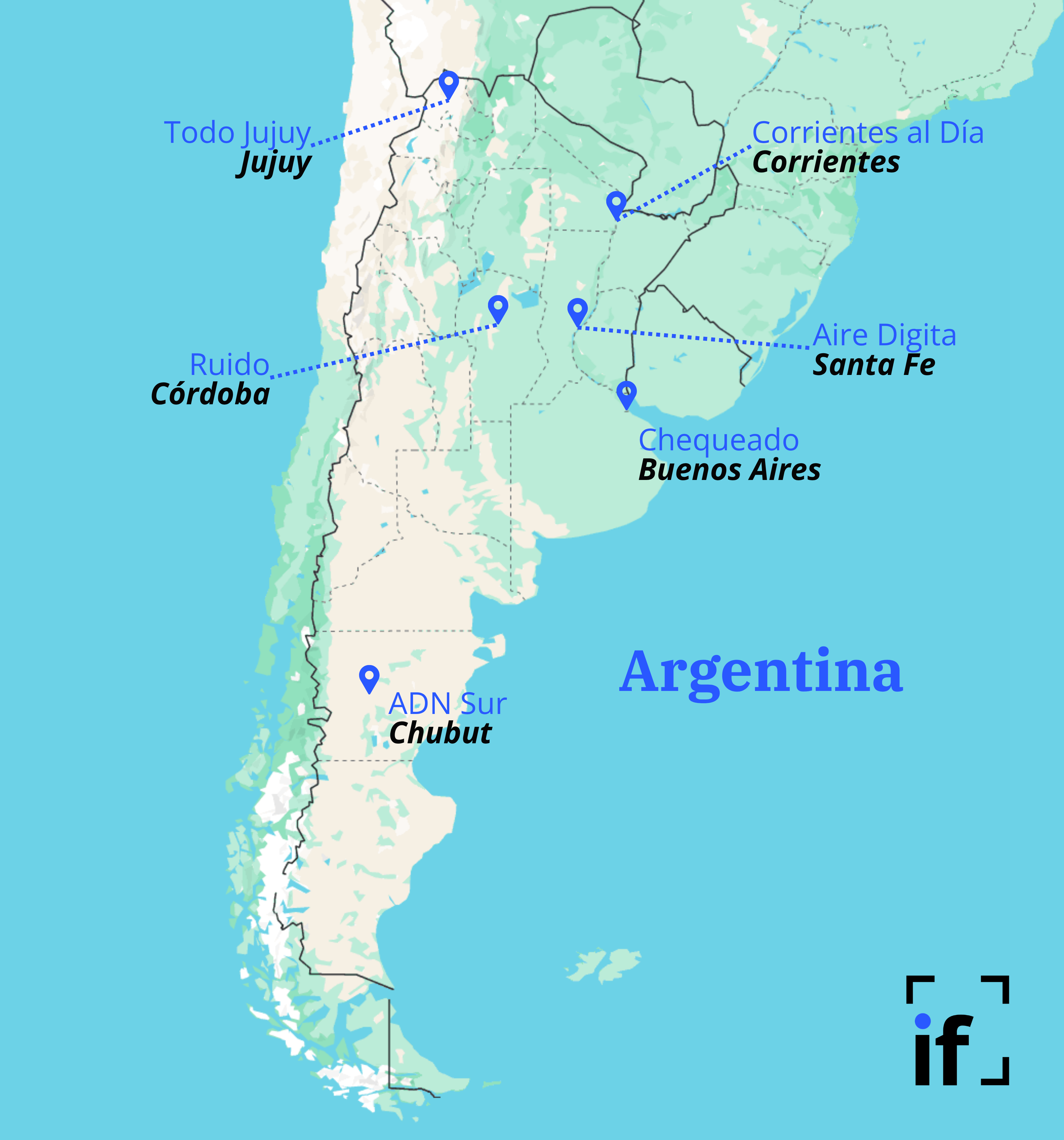
To address these access challenges, the Buenos Aires-based non-profit media outlet Chequeado launched the Federal Network of Innovative Journalism (RPI) in January 2025 with International Fund support. Founded in 2010, Chequeado aims to enhance public debate and democracy in Argentina through fact-checking, investigative journalism and innovation.
Chequeado’s new collaboration brings together five local publishers that operate in geographically isolated areas across the country, where media presence is limited. These local network members, ADN Sur (Chubut), Aire Digital (Santa Fe), Corrientes al Día (Corrientes), Ruido (Córdoba), and Todo Jujuy (Jujuy), together reach an audience of over six million people per month.
The Federal Network of Innovative Journalism has several mutually reinforcing objectives: the Network aims to prevent news deserts by supporting and connecting media that operate far from major urban centres. The network members also collaborate to reach new audiences by reporting in native languages, and creating content targeted at younger audiences. In addition, the newsrooms work on investigations of national scope by leveraging coordination between members of the Network.
To achieve these goals, the media outlets tap into the benefits of multiple news teams working together, and are in daily contact to identify opportunities for collaboration. Coverage of stories such as the 2026 Patagonia fires, or an investigation revealing shortages of medical supplies and medicines caused by government inefficiency would not have been feasible without the network’s resources and capacity.
Cooperation within the Federal Network also goes beyond shared investigative reporting and publication: the Network promotes peer learning and collaborative growth among journalists from different provinces. As the lead and initiator, Chequeado offers its partners training on techniques to identify information gaps in underserved regions, how to file public information requests and build local data repositories, and on how to interpret datasets. Network members also share their knowledge of investigative tactics, digital security for journalists, AI usage policies, andmore.
“As the information ecosystem rapidly evolves, we’re innovating in formats and storytelling to ensure rigorous journalism can compete, engage audiences, and endure in an increasingly fragmented media landscape. In our first year, we reached semi-news deserts, where local voices are disappearing, and reconnected these communities to reliable reporting. This work confirmed a vital truth: that rebuilding local journalism infrastructure is one of the most effective interventions for protecting democratic institutions and strengthening civic engagement.”
–Franco Piccato, Executive Director, Chequeado

As a result of being able to provide expanded and enriched journalistic content, The Federal Network is increasing its members’ audience reach. As of mid-2026, the Network had jointly produced more than 140 content pieces, including explainers, data-driven stories, fact-checking, visualizations, and federal investigations. Taken together they reached 2.1 million views of these web articles, and 5.7 million views of related content produced for social media channels.
In addition, the Federal Network’s work has been cited widely in external publications, including by top national outlets such as Infobae, La Nación, Perfil, and Crónica. Notably, the FederalNetwork won the ADEPA Award in the “Scientific Journalism” category for its investigation: “Measles outbreak: no Argentine province reaches 95% coverage of the triple viral vaccine, as recommended by PAHO.” The Network also published an award-winning story produced by members of the Network about lack of neutrality in provincial courts, with six out of ten of judges found to be having ties to a political party, or politically linked employment.

After just over one year, the Federal Network of Innovative Journalism's collaborative work has demonstrated immense impact, and represents a model with great potential in other countries and contexts.
“The challenges facing journalism today can only be addressed through collaborative efforts and creative solutions. This media network presents a unique opportunity to strengthen journalism with new perspectives, collaborative innovation, and the transfer of technology and knowledge,enabling us to reach new audiences with verified, high-quality information. At AIRE, we are convinced that this is the path to contributing to a more democratic, diverse, and sustainable information ecosystem,”
-Mario Altamirano, Director, AIRE Digital


.jpg)